
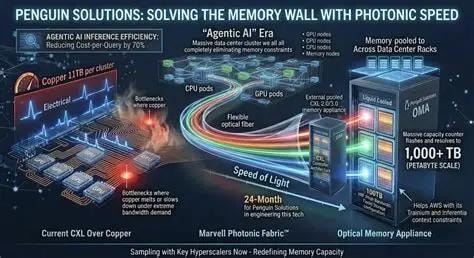
The hard drive is dying. Not from competition — from physics. Silicon-based storage has reached the atomic limits of miniaturization, and the industry knows it. The replacement is already in the lab: photonic memory, where light does the work that electrons used to do.
The fundamental problem with electron-based storage is heat and latency. Moving electrons through silicon generates resistance, resistance generates heat, and heat is the enemy of density and speed. You can engineer around it — but you cannot engineer around thermodynamics.
What Photonic Storage Actually Is
Photonic storage uses light — photons — to encode, transmit, and retrieve data. Because photons have no charge and no mass, they do not generate resistive heat. They travel at the speed of light in the medium. And they can carry multiple data streams simultaneously through wavelength multiplexing.
The breakthrough that changes the equation is the photonic integrated circuit — a chip that processes data in the optical domain without converting to electrons, eliminating the translation latency that has held photonic storage back.
LiT OS and the Photonic Stack
"Silicon gave us computation. Neural nets gave us simulation. Photonics gives us something different: intelligence that lives in light."
LiT OS — the operating system at the core of the LiT Universe — is designed from the ground up for photonic hardware. Rather than retrofitting a silicon-era OS onto photonic infrastructure, LiT OS treats light-speed memory and optical processing as first-class primitives.
The patent-pending architecture separates the data plane (photonic) from the control plane (electronic), allowing each to operate at its natural speed. The result is a system that can process AI inference workloads at speeds that silicon architectures cannot approach — not because of better engineering, but because of better physics.
The Timeline
Commercial photonic storage at the enterprise level is 3-5 years out. Consumer-grade photonic memory is a decade away. But the architectural decisions being made right now — in labs at MIT, Stanford, and in the LiT Universe ecosystem on the Space Coast — will determine who controls the photonic stack when it arrives.
The hard drive had a 70-year run. Its replacement will not be announced with a press release. It will arrive as a series of incremental benchmarks, each one quietly making the previous generation obsolete.


